News & Events
The Boston Globe: Esther Solondz
The Boston Globe
Theater & Art
GALLERIES
Intricate structures
By Cate McQuaid | GLOBE CORRESPONDENT February 6, 2013
When you first walk in Gallery NAGA’s door, most of Esther Solondz’s chilling and peculiar installation, “The Slow Vast Heave of Matter That Just Floats in the World,” is hidden by a movable wall. The title is scrawled in pencil, and a small, fading print of a woman hangs there. You can’t even make out her features.
Step past the wall and you’ll find tables, each with an intricate structure that might be a bird cage made with thread, cobwebs, and dewdrops. The spindly webs are silicon strung over wire, often glistening and translucent, sometimes thick and white as frosting.
The structures sport ornate curlicues and finials. There’s something Seussian about them as they tilt and curl, but they also look like the forgotten skeletons of wedding cakes, which brings to mind the specter of the never-to-be-married bride, Miss Havisham, in Dickens’s “Great Expectations,” who wore her wedding dress decades past its expiration date.
This uneasy sensation is amplified by smaller pieces suspended from the ceiling on big hooks, with heavy black thread. Some, clad in gauzy fabric, sway like ghosts. Others, pink and white and drippy, are cylinders ringed with tutus, or bell shapes with droplets clinging to their rims.
Everything here appears to droop and cave in. At the same time, the art glimmers like diamonds and beckons like cupcakes. It looks fragile and on the verge of dissolution, yet has the feeling of eternity about it. Solondz powerfully stirs up vanquished hope and lingering fear with this installation of discrete pieces. Imagine if she could create a structure, large enough to walk inside, of wire, and dewdrops, and decay.
Esther Solondz Press Release
The Slow Vast Heave of Matter
That Just Floats in the World
February 1 – 23 at Gallery NAGA
In February, Gallery NAGA's exhibition space will be occupied by Esther Solondz's complex and ephemeral installation The Slow Vast Heave of Matter That Just Floats in the World.
The Slow Vast Heave of Matter That Just Floats in the World is on exhibition from February 1 through 23. A reception for the artist and the public will be held at the gallery on Friday, February 1 from 6 to 8 pm.
The continuing evolution of Esther Solondz’s fascination with and experimentation with materials that transform is expressed in her new work. For the past ten years, she’s worked with substances that, over time, turn themselves into something else: dripping salt water that forms stalagmites, iron filings that rust to leave a suggestive half-here, half-there image. This installation is comprised of materials—steel, thread, and silicon rubber—one might assume would transform or dissolve, but in fact are much more stable.
The Slow Vast Heave of Matter That Just Floats in the World is an installation made up of structures hanging from the ceiling, propped on pedestals, and slowly rotating from the ceiling with fabric drifting between them. The structures are made out of steel then wrapped in thread and then coated in silicon rubber. Some are so tall and precarious while others are so heavy with dripping silicon they look as if they might topple over at any moment.
The overall feeling of the work is one of weightlessness. Some structures appear as if they have just arrived and others appear as if they might be on their way to another plane of existence. They hover, held up by string, or float on sheer fabric. "I was trying to make structures that paradoxically had the most minimum amount of structure. Impossibly light, which of course was impossible. I kept thinking I wanted them to have no structure at all - that they could be released from the constraints of the materials that were necessary to hold them up. I tried to counterbalance the grounded weight with structures that were tethered from above. Together I felt that they created some kind of equilibrium - a delicate balance, a fragile beauty, akin to floating,” Solondz says.
Images of work to be exhibited by Esther Solondz can be seen as of February 1 at gallerynaga.com.
The Boston Globe Review: Louis Risoli and Yizhak Elyashiv

The Boston Globe
Theater & Art
GALLERIES
Shifting perspectives; landscape by number
By Cate McQuaid | Globe Correspondent January 16, 2013
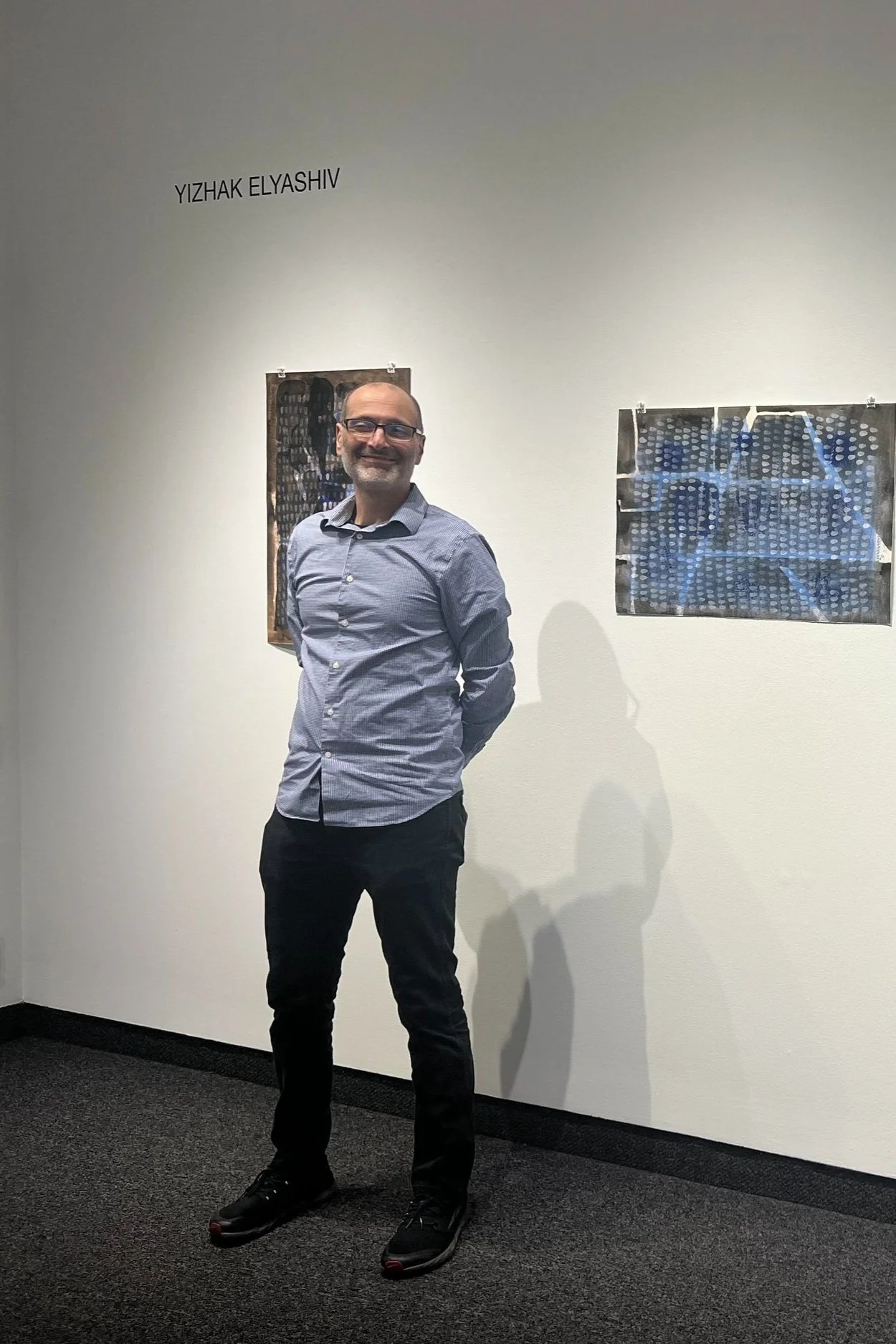
Over the years, the printmaker Yizhak Elyashiv has gone from diagrammatic abstraction based on chance — he’d toss a handful of rice, say, onto his printing plate and chart the grains — to a deep consideration of landscape. It’s not that far a leap. In his show at Gallery NAGA, he still applies discrete gestures and algorithms to his work, all as a means of exploring the land.
“Untitled (#4),” for instance, conveys rolling hills in swarms of small, smudgy engraved marks. Elyashiv writes in his artist’s statement about working in Ireland, and studying the history of the potato famine. “Sulfuric fields,” he writes, were said to stink with the scent of rotting spuds.
It’s hard not to see those spent potatoes in these sooty marks. Then, some rise from the landscape into the air, like ocean spray over a wave. The artist draws fine lines networking the smudges, and writes numbers, counting from zero to nine again and again throughout the print in pink watercolor. The numbers and lines come across as the artist’s attempt to apprehend the land, and all the history and sorrow that it holds.
Also at Gallery NAGA, Louis Risoli’s dense, smart, joyful paintings include five big triangular canvases bubbling with pattern and demented hues, and one grid of smaller rectangular paintings filling a wall. “Edie,” a triangular piece well over 5 feet tall, sports intersecting circles. Risoli fills the overlaps with swipes of lime green and peachy cream. The parts that don’t overlap are white, but they blush like schoolgirls.
“Let X=X,” the grid of paintings, is full of delights. On one checkerboard of deep pink squares, the surface crimps and rumples, and in places rises as if there are jar lids embedded beneath. Another shows yellow diamonds on a red-gingham type background; the diamond in the middle looks like thick frosted glass, with shadows and streaks beneath it.
These painterly, off-kilter works and their juicy patterns suggest textiles, and microbial cross sections you might see through a microscope. Patterns are everywhere; we’re in them, and tied to each other by them. Risoli’s work celebrates that.
Gallery NAGA: Best shows of 2012 in Boston-area art galleries
The Boston Globe
Theater & art
GALLERIES
Best shows of 2012 in Boston-area art galleries
By Cate McQuaid | GLOBE CORRESPONDENT DECEMBER 25, 2012
Contemporary art is growing more conceptual, more 3-D, and more virtual, but in the midst of it all, painting holds its own. It's the most expressive medium, full of light, color, and the sweep or concision of the artist's hand. Meanwhile, alternative spaces are making a comeback (Lincoln Arts Project, Lot F Gallery, and more), and performance art is experiencing a rebirth in these parts, as galleries such as Anthony Greaney, Samson, and Proof invite young performance artists to strut their stuff, and others take to the streets and the waterways. Here are some of my highlights of the year, in no particular order:
In May, Heidi Kayser anchored a raft in Fort Point Channel and undertook "The Remodeling Project,'' a monthlong series of performances as part of Fort Point Art Community's Floating Art Series. She regularly kayaked out to the raft to change the setup there - into an office space, a front yard, or whatever came to mind. Each visit to the raft, with its attendant chores, was a performance. A terrific public art project, it engaged passersby while posing questions about personal space.
Another performance artist, Derrick Adams, in "The World According to Derrick: Performative Objects in Formation" at the Boston Center for the Arts' Mills Gallery, showcased his videos and sculptures in an exhibit curated by Nuit Banai. Many of Adams's works exposed and played with stereotypes about black masculinity, and others used iconic American imagery to deconstruct tired, if persistent, assumptions. If that sounds earnest and scolding, it wasn't - Adams's vision is funny, and tinged with sweetness.
For the utterly weird, Josh Mannis's video "Zeal for the Law" at Anthony Greaney couldn't be topped. In it, Mannis, a portly guy in a blond wig, gold chain, and white mask, gyrates to a wild drumbeat. At first he's alone, but then there are two or more of him, and the repetitive image has almost neural effects. Mannis is something of a trickster and a shaman, perpetrating visions upon the viewer through rhythm, hallucination, and his wily and blatant otherness.
The late Boston Expressionist Hyman Bloom had a revelatory show at Alpha Gallery. Bloom, who died in 2009 at 96, was a forceful painter who grappled with faith in the face of suffering. His works here, dating from the 1940s until his death, were mythic, dark, and exuberant. The jittery energy and opulent tones in "Leg on Table," depicting a decomposing limb, expressed the vitality of decay. Bloom was a powerhouse who spent most of his career in obscurity. This was his first gallery show in years. He deserves more.
Gallery NAGA had two exhibits in a similar vein. Painters Henry Schwartz, who also died in 2009, at 81, and Gregory Gillespie, who died in 2000 at 64, could both be considered second-generation Boston Expressionists (granted, Gillespie lived in the Pioneer Valley). Like Bloom, they made emotionally fervent, painterly work.
Schwartz's diptych "Untitled (self-portrait with muses)" was the jewel of his show. It depicted a schoolboy contemplating a row of towering nude women, gray-skinned with protruding ribs, but also possessing large breasts and pronounced curves, which married sex and death in the same harrowing image. Gillespie, like Bloom, displayed a probing spirituality in paintings that were technically and chromatically brilliant, but often brooding and occasionally monstrous.
For his exhibit at Steven Zevitas Gallery, Peter Opheim painted figures he had built out of clay. The large-scale paintings made something cute and toy-like confrontational and strange, articulated in loose, sometimes aggressive strokes. Opheim set some of his blobby people in pairs and groups, suggesting sex and other activities, unnervingly blending themes of childhood and adulthood.
Steve Locke, who will have a solo show at the Institute of Contemporary Art in 2013, offered a sneak peak with his subversive and funny paintings at Samson. Locke has for a long time made luscious paintings of men who seemingly resist the viewer's gaze - they stick their tongues out, they close their eyes. In this show, he further activated that perceived interchange by mounting his paintings on poles jutting up from the floor, a move that co-opts a trend toward making painting more sculptural. Not coincidentally, Locke will have work in the deCordova Sculpture Park and Museum's show opening next month, "PAINT THINGS: beyond the stretcher."
"Simpatico," a sharp and delectable group exhibit put together by director and chief curator Kate McNamara at Boston University Art Gallery at the Stone Gallery, spotlighted contemporary abstract painters who revel in the materiality of paint. They were all women, appropriating action painting, a movement mostly associated with men, and brought an unabashed and lighthearted spirit to it, throwing on the glitter and the neon rainbows.
The highlight of conceptual artist Annette Lemieux's exhibit, "Unfinished Business," at the Carpenter Center for the Visual Arts at Harvard University was the installation "Things to walk away with," an array of found objects, set on the floor in rows according to height, in a formation akin to the Latin cross layout of Chartres Cathedral. These included a flattened earmuff box, helmets, and cloven hooves made into candleholders. Together, these objects accrued meaning, and seemed to move toward epiphany, all of which was yours to ascribe.
Finally, "Edifice Amiss: Constructing New Perpectives," organized at the Massachusetts College of Art and Design by Lisa Tung, director of curatorial programs, was a bracing and beautiful show that woke viewers up to how we experience space, from the ethereal architecture of David Henderson's work to the elemental geometry of Esther Stocker's, and including Lead Pencil Studio's playful, intricately detailed re-creation of a city street, all in blank-faced wood.
Favorite Things: Art Made Around Boston

Benjamin Evan's show at 17 Cox titled "You Are Here" made the cut for "Favorite Things: Art Made Around Boston" written by Greg Cook for WBUR.
"Benjamin Benson Evans in “You Are Here!” at 17 Cox, April 25 to June 23, 2012.In his installation “TV Dinner,” the Boston artist created a walk-in story. He transformed the space into a cramped, down-at-the-heels living room right out of 1990 (down to the copy of “People” magazine with “Most Wanted Woman” Paula Abdul on the cover). The clip of “Casablanca” screening on the television, the portraits of a man and woman hung on the wall were clues adding up to a story of love and loss. The attention to detail was astonishing—and signs of Evans’s growing talent."